ADA Handicap Obtainable Portable Washroom Rental: What Federal Requirements Cover
When individuals ask whether they need an ADA handicap available portable washroom, they are generally attempting to solve a really sensible issue. A celebration organizer intends to stay clear of leaving out visitors. A school or church is planning an exterior occasion. A specialist is trying to understand whether the exact same rules apply on every site. A residential or commercial property manager is aligning an ada portable bathroom rental and wants to get it right before delivery day.
The tough part is that mobile washroom conformity obtains discussed in a great deal of loosened, certain language. You will certainly listen to people state an unit is "ADA design," "mobility device friendly," or "compliant enough." Those expressions do not inform you much. What issues is which federal requirements use, how many easily accessible systems are called for, and whether the unit is really useful once it is gone down on the ground.
At the government level, the controlling standard is the 2010 ADA Standards for Accessible Layout, as translated by the united state Accessibility Board and the Department of Justice. That is the foundation for comprehending what an ada easily accessible portable bathroom must cover. If you are renting out mobile toilets for public usage, temporary occasions, or various other general-access settings, that is the location to start.
The federal policy people most often miss
The most typically missed point is straightforward: ease of access is not only about the washroom system itself. It is also https://pristineportablesil.com/service-area-galva-il/ about where it sits and just how a person gets to it.
A lot of mobile bathroom setups fall short in the real world not since the vendor provided the wrong shell, however due to the fact that the accessible system wound up throughout soft ground, behind a curb, at the end of a steep shift, or with too little handling space at the door. On paper, someone purchased an ada certified portable commode. On website, the route made it unusable.
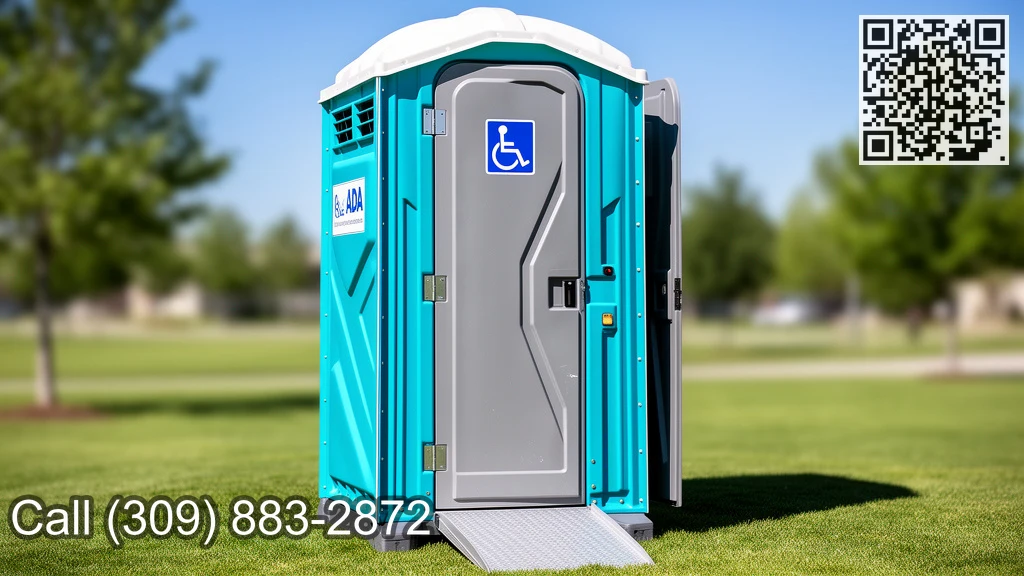
Federal standards treat those issues as component of access, not as side notes. An obtainable mobile unit must have an available path and entrance, and any type of required ramps or touchdowns need to comply with the applicable ADA technological demands. That matters at a street fair, in a park, at a seasonal location, and at any kind of short-lived event where units are organized in a cluster.
This is one factor the expression ada portable restroom can be misinforming when it is made use of casually. It seems like compliance lives totally inside the walls of the unit. It does not. Ease of access begins before the door opens.
What standard regulates an ADA mobile toilet rental
For basic portable commode services in the USA, the managing federal access requirement is the 2010 ADA Standards for Accessible Layout. The Access Board and the Division of Justice are the vital government interpreters in this area.
That appears completely dry, yet it has a practical impact. If you are comparing carriers for an ada portable commode rental, you are not just purchasing a bigger system. You are searching for a device and placement that line up with government ease of access regulations. A supplier may explain inventory as ada-compliant portable bathrooms or ada compliant mobile commodes, but that tag only indicates something if the required attributes and site conditions are in fact in place.
The criteria also explain that temporary settings do not get a free pass simply because they are temporary. That shows up constantly with outdoor wedding events, fairs, sports events, shows, charity runs, and pop-up job zones that offer the general public. A short event can still set off the requirement for accessible portable sanitation.
The 5 percent rule for collections of portable commode units
If portable single-user toilet devices are provided in a collection, at the very least 5 percent of the systems in each cluster should come. The Gain access to Board has made clear that this uses also at momentary events.
That one sentence cleans up a massive quantity of confusion.
Some organizers think that if they have one accessible unit someplace on the residential property, they are covered. Federal scoping is much more certain than that. The need puts on each collection. If you spread portable toilets across a location, each grouped financial institution of systems has to be thought about on its own.
That factor matters for large websites. Picture a fairground with one collection near the entryway, an additional by the food location, and an additional near an efficiency phase. The logic of the regulation is evident once you stand in the shoes of a guest with movement restrictions. If the only ada handicap accessible portable bathroom is at the front entrance, yet the guest is spending the evening near the stage beyond of the grounds, gain access to is not meaningful.
There is likewise a practical planning lesson right here. The obtainable units ought to be built right into the site map initially, not dealt with as last-minute attachments. When they are an afterthought, they commonly wind up placed anywhere there is leftover area, which is usually the most awful feasible location for course accessibility and maneuvering.
What makes a mobile bathroom available under federal standards
People frequently desire a brief response below, however the sincere answer is that a number of technological elements work together.
An available mobile unit must be identified with the International Symbol of Accessibility. That marking is not decoration. It informs users and staff which unit is meant to provide available usage. On a busy site, excellent identification saves confusion and minimizes the possibility that the easily accessible unit obtains dealt with like simply another basic unit.
Beyond recognition, the system has to satisfy toilet-room technological demands. Federal advice indicate fixture clearances, transforming space, and door maneuvering clearances, in addition to applicable grab-bar and water-closet clearance guidelines. Those terms may seem extremely technical, yet they all talk with one functional inquiry: can a person go into, position themselves, transfer, and utilize the bathroom with affordable safety and dignity?
Turning room matters due to the fact that size alone is not the same as usability. A room can feel "bigger" and still not sustain the activities a customer needs to make. Door steering clearance matters since the hardest component of using a bathroom is often not the interior fixture, however managing the door while entering or exiting. Get hold of bars and component clearances matter for balance, transfer, and stability.
That is why the old shorthand, "just order the big one," is not reputable. A larger shell is not instantly an ada certified available mobile restroom. Federal standards have to do with feature, not marketing descriptions.
Temporary events still count
This is just one of the locations where well-meaning coordinators obtain captured off-guard. They presume accessibility policies are generally targeted at irreversible structures and long-lasting facilities. For mobile washroom clusters, that is not how federal scoping works.
The Access Board has specifically stated the 5 percent accessible-unit rule applies even at short-term occasions. That implies the duration of the event does not get rid of the requirement. A weekend break festival, a one-day fundraising event, or a seasonal celebration may still need ada certified mobile toilets in the right ratio, with the correct access to and into the unit.
I have seen organizers spend weeks on auto parking, ticketing, secure fencing, and power, then leave restroom accessibility to the last vendor call. That is where avoidable errors happen. A website can have sufficient bathrooms total and still stop working customers who need an accessible alternative neighboring and on a functional route.
Temporary sites likewise often tend to present ground-condition issues that permanent websites do not. Turf, gravel, mud, momentary flooring, and unequal changes can turn an otherwise ideal ada portable commode right into something that is technically existing however almost unreachable. Federal standards do not stop at the device door, and neither should occasion planning.
Placement can make or break compliance
This is where area judgment matters.
Suppose you rent an ada-compliant portable bathroom and location it past a rough patch of ground, over a lip produced by mats, or beside a location where rain pools. On a website map, you have inspected package. On the ground, the path might no more be accessible in any type of purposeful way.
The government requirements require an obtainable path and entryway. If ramps or touchdowns are required, those aspects also need to satisfy ADA technical needs. That tells you two things. Initially, shipment alone does not end up the work. Second, site problems ought to be examined before the vehicle shows up, not after the system is embeded in place.
A lot of stress can be stayed clear of by strolling the precise path a guest would certainly make use of. Begin where the general public enters or gathers. Comply with the path to the bathroom location. Search for slopes, changes, traffic jams, and unsteady surfaces. After that take into consideration just how the unit door will open up and whether the technique area leaves enough room to maneuver. Those are not abstract compliance exercises. They are what establish whether someone can utilize the toilet independently.
Here is a short checklist that helps capture the most typical mistakes prior to shipment day:
- Confirm how many portable bathroom clusters the site will have, not simply the total number of units.
- Make sure each collection has the called for accessible device count.
- Verify that the obtainable device will be noted with the International Symbol of Accessibility.
- Walk the route to the device and check the entrance area, consisting of any type of ramp or touchdown that may be needed.
- Ask the supplier and site team to assess positioning together prior to last set-down.
That brief conversation between organizer, supplier, and site lead is usually the distinction between a certified arrangement and a scramble on opening morning.
What government criteria do and do not claim regarding construction sites
Construction job includes a crucial wrinkle.
There is a difference in the ADA standards background for mobile toilet devices at building websites made use of exclusively by building personnel. The older 1991 criterion consisted of an exception from the portable-toilet access scoping need for those exclusive-use building and construction setups. For basic portable toilet rentals, the accessible-unit requirement remains.
This is where people can obtain floundered by half-remembered suggestions. Somebody listens to that "building and construction sites are exempt" and repeats it generally. That is too simplified. The confirmed federal context is narrower than that. The exemption noted in the 1991 standard was connected to portable commode devices at construction websites made use of solely by building and construction employees. That is not the like a blanket exemption for every mobile toilet plan linked in some way to construction activity.
If the portable commodes belong to public use, or part of a setting outside that particular special construction-personnel context, you must not think the exception uses. This is one of those locations where wide assumptions produce risk quickly.
It is also worth noting that accessibility responsibilities are being implemented in a wider compliance environment. Federal ADA activity has not decreased. One indication of that bigger climate is the Division of Justice guidance provided in April 2026 expanding the due date for sure state and city government web and mobile accessibility rules to April 26, 2027 for bigger entities. That support is not regarding mobile toilets, yet it does reflect a recurring and active compliance landscape. The useful takeaway is that access is not a dead letter problem. It stays significantly active across sectors.
The language suppliers make use of, and what you must ask them to mean
The portable cleanliness market uses numerous overlapping terms. You will see expressions such as ada certified mobile restroom, ada certified portable washrooms, ada-compliant portable washrooms, ada mobile toilet, and ada certified portable commode. Sometimes they are made use of carefully. Sometimes they are bit more than sales shorthand.
What you desire is not just a label, however verification that the rental configuration addresses the federal points that matter.
Ask whether the unit supplied is meant to please easily accessible mobile bathroom needs under the 2010 ADA Criteria for Accessible Style. Ask just how the system is identified. Ask whether the shipment group has experience placing accessible systems on short-term websites with course concerns. Ask that is accountable for last placement if the website problems are not suitable on arrival.
That last concern is especially essential. In method, bathroom vendors, event planners, and homeowner commonly each presume somebody else is handling accessibility details. The vendor might think the consumer selected the place with path problems in mind. The consumer may think the vendor will decline a poor area. The website supervisor might presume the easily accessible device can merely be moved later on. By the time everybody recognizes there is a problem, the event is underway.
An understanding approach assists below. Accessibility preparation goes much better when it is treated as solution, not as an aggravation. The objective is not to "cover obligation" in the abstract. The objective is to make certain a person that requires an accessible bathroom can discover it, reach it, enter it, and utilize it without undue difficulty or embarrassment.
Common edge instances that are worthy of even more thought
A solitary obtainable device at the much side of a huge venue is a traditional difficulty spot. So is breaking toilets into numerous clusters and forgetting that the 5 percent rule uses by collection. One more typical problem is positioning an available system where assistance vehicles can reach it quickly, yet customers cannot.
Weather can subject weak planning fast. A path that seems acceptable on a dry setup day can wear away after rainfall. Soft ground, rutting, and pooled water can weaken gain access to also when the device itself is the right type. The government requirements do not transform with the forecast, so short-term sites require a little humility and back-up thinking.
The identification issue is more important than some groups realize, as well. If the system is not plainly noted with the International Symbol of Availability, guests may lose time opening multiple doors, personnel may guide them inaccurately, and conventional devices may become crowded while the obtainable unit goes unnoticed. Clear noting is a basic however purposeful part of usability.
Choosing the best frame of mind for an ADA mobile bathroom rental
If I needed to lower the federal criterion to one useful attitude, it would be this: assume in terms of the whole individual experience, not simply the rented object.
A certified setup is not developed by getting one bigger restroom and calling it done. It originates from matching system matter to gather matter, making certain the available devices are really recognizable, and positioning them where the path and entry work in genuine conditions. It also implies understanding where the restricted construction-site exemption historically fits, and where it does not.
That approach has a tendency to alter the top quality of preparing today. Instead of asking, "Do we need one unique system?" the far better inquiries become, "How many clusters do we have? Which devices in each cluster come? Can a guest reach them on an available route? If a ramp or landing is required, has that been addressed under ADA technological needs? Will the entryway and indoor clearances sustain actual use?"
Those are much better questions because they are grounded in the standards that in fact govern.
What this implies for organizers, property supervisors, and renters
For most general-use leasings, the takeaway is uncomplicated. If you are arranging portable bathrooms for the general public or for a temporary event, federal access standards become part of the work. At least 5 percent of mobile single-user commode devices in each collection should be accessible. The accessible device needs to be understood the International Sign of Accessibility. It has to have an available path and entry, and any required ramps or landings have to comply with ADA technical requirements. The system has to additionally satisfy the relevant toilet-room technical demands, including component clearances, transforming area, door navigating clearances, and suitable grab-bar and water-closet clearance rules.
That is the government structure. Whatever else, the scheduling, delivery timing, ground prep, and positioning coordination, ought to support it.
Handled well, an ada handicap easily accessible portable toilet is not a difficult add-on. It is a fundamental part of making a website useful for real individuals. And when you have seen someone arrive at an event, area the accessible device easily, traveling to it without challenges, and utilize it without needing to ask for aid, the factor of the criteria comes to be very clear. Availability done correctly does not call attention to itself. It just enables individuals to take part on more equivalent terms.
 Ask ChatGPT
 Ask Grok
 Ask Perplexity
 Ask Claude
 Ask Google AI
 Ask You